
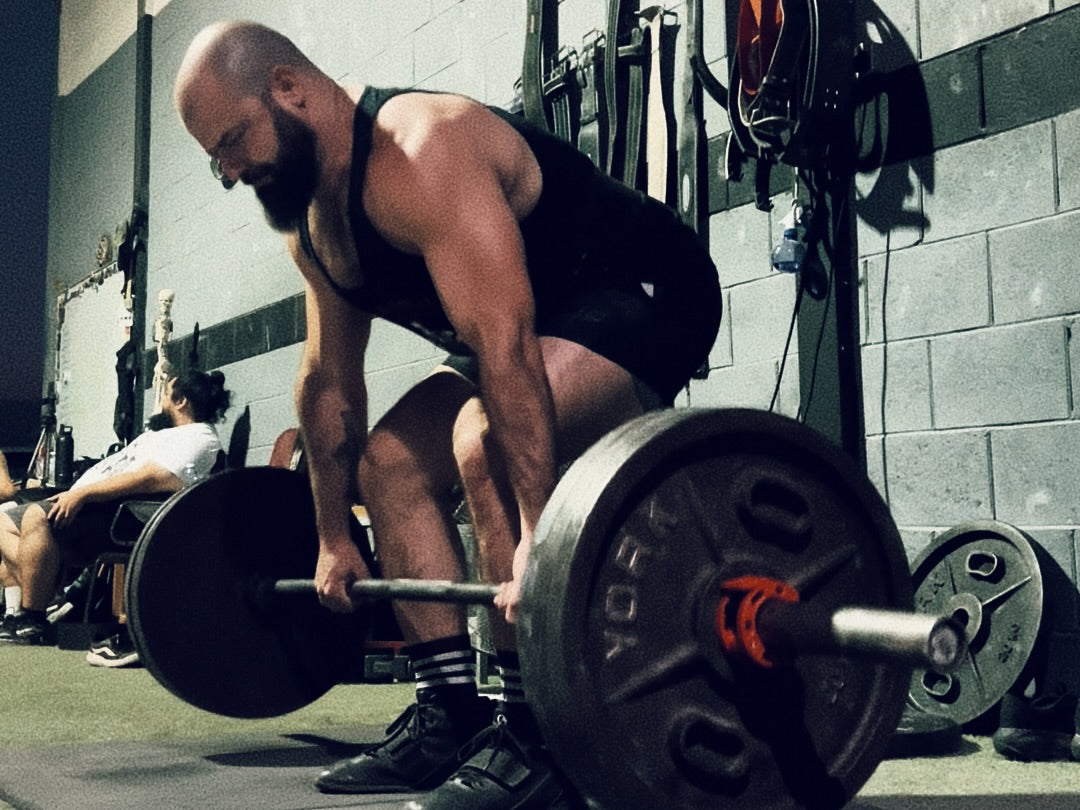
Want to know the one cue that will unlock your deadlift?
It's not a new program. It's not a fancy belt or a pair of straps. It's a single shift in how you think about the lift.
The deadlift is not a pull. It's a push.
I know what you're thinking. You're literally pulling the bar off the floor, Alex. Stick with me.
You're not a crane
A crane stays planted and hauls the load up with its arm. That's a barbell row: your legs and hips stay still, and your lats and upper back drag the weight towards you. That's a pull.
The deadlift works differently. Your legs are the prime movers. When the bar breaks the floor, it's because your legs are driving the ground away through your feet. Once the bar passes your knees, your hip extensors (glutes and hamstrings) take over and drive your hips forward to lockout.
Your back isn't lifting anything. Your lats, traps and spinal erectors are stabilisers. They hold tension, keep the bar tight to your body and stop you folding in half. They're not doing the work of getting the weight up.
Simple physics
This is Newton's third law: every action has an equal and opposite reaction.
You don't lift the bar by yanking it upwards. You press down into the floor, and the floor pushes you and the bar up. The force starts at your feet.
If the deadlift were really a pull, the force would come from your hands and back. But your hands should be hooks, like chains hanging from your shoulders. Your back is just a rigid link between your legs, your arms and the bar.
The bar won't move until you push the earth away.
Why your deadlift has stalled
Plenty of lifters (me included, for years) try to deadlift with their lower back. They grip the bar and heave with everything above the hips.
The result? Hips shoot up, the back rounds over, the rep falls. And if you're unlucky, you're walking around with a tweaked lower back for the next week. I've lost count of how many times that's happened to me.
All because of one bad mental model.
Set up like you're about to jump
Think of your deadlift setup like a standing vertical jump:
- Feet roughly hip-width apart (adjust for your own build)
- Bar over your midfoot
- Shins close to vertical
- Hips lower than your shoulders
- Arms just outside your knees, gripping the bar like you mean it
From there, brace hard, keep your back flat and stable, squeeze the bar and push the floor away with your legs.
That's it. No yanking or rowing the weight off the ground. Just leg drive, a rigid torso and a hard grip.
Brace before you push
Leg drive is useless if your torso folds. Before every rep, take a big breath into your belly, not your chest, and brace your abs like someone's about to punch you. Hold that breath until you're past the hardest part of the lift. A belt helps by giving your abs something to push against, but it won't brace for you.
Pull the slack out
Don't jerk the bar off the floor. Before you push, pull up on the bar with your lats just enough to take the slack out: you'll hear the plates click against the sleeves and feel the bar bend slightly. Arms long, lats tight. Now the whole system is locked in, and when you push the floor away, every bit of force goes into the bar instead of into slack.
Two faults and how to fix them
Your hips shoot up first. The bar stays on the floor while your hips rise, and you end up doing a stiff-legged deadlift with your lower back. That's the classic sign you're pulling instead of pushing. Think chest and hips rise together, and drive through your whole foot as the bar breaks the floor.
The bar drifts away from you. The further the bar travels from your body, the longer the lever on your lower back and the heavier the weight feels. Keep it close enough to scrape your shins and thighs. Think about bending the bar around your legs, with your lats pulling it into you.
Accessories that build leg drive
- Paused deadlifts. Pause for two seconds just below the knee after the bar leaves the floor. You'll learn to hold your position and keep pushing.
- Deficit deadlifts. Stand on a 2 – 5 cm plate or platform. The longer range of motion makes your legs work harder off the floor.
- Front squats and Bulgarian split squats. Stronger legs mean a stronger push.
Pulling sumo? The cue works even better. With a wide stance and an upright torso, the sumo deadlift is even more of a leg press. Spread the floor apart with your feet and push it away.
Try it
Next time you pull (sorry, push), stop thinking about lifting the bar and start thinking about driving the floor down.
I guarantee your deadlift will improve.
Pulling heavy this week? Do it in gear built for the platform: shop our powerlifting apparel.