
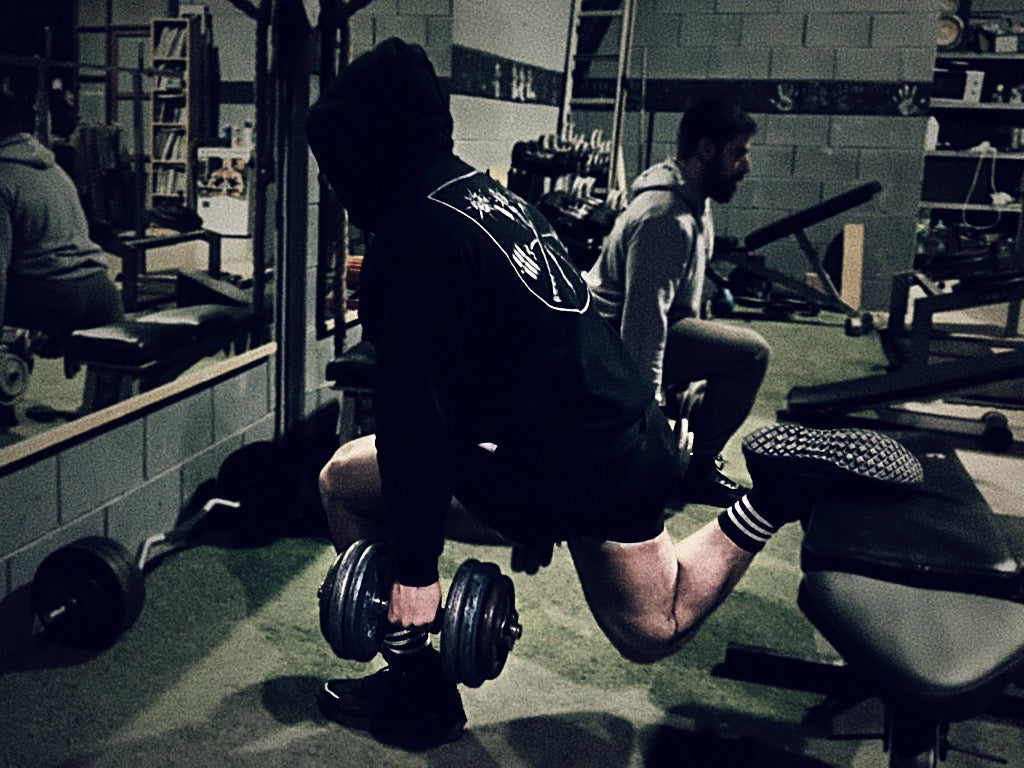
There's one lower-body exercise I swear by that most lifters avoid like the plague.
The infamous, the notorious Bulgarian split squat. Or as I call it, the barbarian split squat.
Isn't it just a fancy lunge? Maybe. But I program them every Friday as a finisher, a punishment for the week that leaves me sore for the whole weekend. Here's why you should be doing them too.
How I do them
Rest your back foot on a bench behind you, hold a dumbbell in each hand and sink straight down on your front leg as deep as you can, then drive back up.
I warm up with a bodyweight set of 10 per leg, then go straight into working sets.
1. They're insanely effective
The stimulus you get in your glutes, quads, adductors and hamstrings is ridiculous.
At the bottom of the rep, you're in deep hip flexion with a long lever arm, which puts serious tension on your glutes, hamstrings and adductors. Driving out of the hole demands everything your quads and stabilisers have.
Personally, I get more glute work from split squats than from hip thrusts or even regular squats. And you get all of it without the heavy spinal loading of a barbell on your back.
If you sit at a desk all day, your posterior chain and hip extensors are almost certainly a weak link. Split squats will build them up fast.
2. They expose your weaknesses
The split squat is a unilateral movement: one leg at a time. Your weaker leg has nowhere to hide.
In a bilateral lift like the barbell squat, your dominant side quietly picks up the slack. In extreme cases, you'll see lifters shift their hips to one side coming out of the hole because one leg is doing more of the work.
I'm right-handed, and my left leg has always been a little sleepier than my right. Split squats make that obvious, and force the weak side to work alone until it catches up.
Fixing those imbalances does three things:
- Better symmetry in your main lifts
- Better stability in your hips, knees and ankles
- Lower injury risk, because your strong side is no longer compensating for your weak one
And remember: most of life is unilateral. Walking, running, climbing stairs, kicking a ball, sprinting. Single-leg strength carries straight over.
3. You can do them anywhere
No rack. No barbell. No spotter. No gym, even.
All you need is something to rest your back foot on: a bench, a bed, a couch, a chair. Do them in a hotel room on a work trip and walk into your meeting with a leg pump.
They're also one of the safest ways to train your legs hard. There's far less compressive load on your spine, which makes them a great option if you've got a history of back trouble. And if you fail a rep, you just drop the dumbbells. The only real limit on how heavy you can go is your grip strength.
Bonus: they're brutal
This is why I call them barbarian split squats.
Between balancing, grinding and gasping for air, high-rep sets are as much a mental battle as a physical one. Getting through the last few reps takes real focus.
That's why I save them for Fridays. Go out with a bang at the end of the week and start the weekend wrecked in the best way possible.
How to program them
Choose the heaviest dumbbells you can handle for 8 – 20 reps. Higher reps (15 – 20) are where they really shine. Do three sets per leg and finish each set close to failure, around RPE 8 – 9.
Try them on your next leg day. I guarantee you'll hate me for it.
Barbarian split squats deserve barbarian gear. Shop the Barbarian collection.
Already doing split squats? Let me know what benefits you've noticed, and share this with someone whose legs need humbling.